Tuesday, October 19, 2010

The Holy Sacrifice of The Mass: Part IV The Road to Golgotha

The Most Holy Sacrifice of the Mass: a Primer for Clueless 
Catholics
 

A PRIMER for CLUELESS CATHOLICS

The Holy Sacrifice of the Mass

Part IV 

The Road to Golgotha

"With us, that new world of unspeakable life and beauty will be revealed ... when we close our eyes. "As the eyes of the body close, the eyes of faith open. And what they will see, discover to us, reveal, will touch the fiber of our being ... and more than touch it, transform it!"

How so?

Once you begin to understand where you are – really and truly – a change, a profound change, will begin to occur within you. You will be unable to prevent it. Initially – even necessarily – it will come to you through your understanding, and as you enter more deeply into the realization of where you are, your understanding itself will begin to be eclipsed by something deeper still, by something more vital.

Understanding will "tell" you where you are – but faith will take you beyond the appearances, to the the realities beneath them. The change that will come will occur within you – not in the appearances of things about you.

You will have changed.

But as we had also said, before any of this occurs, you must first understand what is happening before you – and it is this, and nothing less than this:

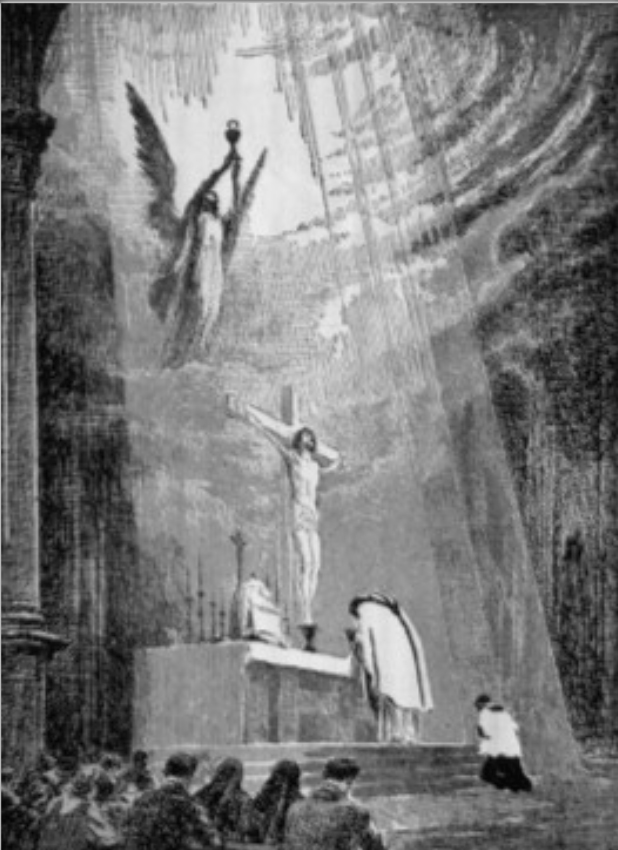
Jesus Christ is being crucified before you. He is on the Cross!  And you are witnessing it. You are even taking part in it!

It is not another Sacrifice, but the same Sacrifice that He enacted 2000 years ago. It is not a "re-enactment" much as great battles are re-enacted for theatrical effect. It is an "enactment", the "same" enactment, re-presented to us (not represented to us, but "re-presented") to us ... enacted again while not being a second or another sacrifice. It is the same Sacrifice, with one exception: it is unbloody ... just as it was unbloody when He gathered His Apostles around Him at the very first Mass on the night He was betrayed and before He was crucified:
"The day before He suffered he took bread in His sacred hands and looking up to heaven, to you, His almighty Father, He gave you thanks and praise. He broke the bread, gave it to His disciples and said: Take this, all of you and eat it: this is My body which will be given up for you. When supper was ended, He took the cup. Again He gave you thanks and praise, gave the cup to his disciples, and said: Take this, all of you, and drink from it: this is the cup of My blood, the blood of the new and everlasting covenant."
(Eucharistic Prayer I)
But now you witness it before you, take part in it ... see the unspeakable value of your life (in His love for you Christ suffered and died) ... and the consequences of your choices (the sins by which and for which He suffered, was crucified, and died)  ... right before you!

Time, we told you, had been left in the vestibule as we entered the Church. It no longer divides us from that day.
We have entered into something sacred, and everything sacred is invested with the eternal, for it pertains to God Who IS eternal; Whose Son is eternal; the Son of God, now here before us on that Cross of agony hewn from our sins.

How then will you enter?
Everything that leads up to the Canon of the Mass (that most sacred part of the Mass in which the Consecration occurs, when the bread becomes Jesus' Body, the wine His Blood) is a prologue to that epic moment when He will be sacrificed before you.
When you passed the doors leading into the Church and toward the Sanctuary, you began to wend your way through the road that leads to Golgotha, the Place of the Skull, the Mount of Crucifixion — the Altar of Sacrifice.

Not unlike 2000 years ago, the people that line the way, the voices, the talking, the laughing, together with all the other things that compete for your attention as you walk that road to your pew – one and all, they will call you aside, distract you as though to call you away from a false prophet on a road well worn and ultimately tiresome ...
Something has changed, however. This day is unlike other days. You have begun to understand ...

How, then, will you enter?


  • What we have learned today: The Mass is the enactment, really and truly present before you, of Jesus' Sacrifice on Calvary, and you have a very real part in it.
     

Monday, October 18, 2010

The Most Holy Sacrifice of the Mass: Part III "I Don't Think We're in Kansas Anymore, Toto"

The Most Holy Sacrifice of the Mass: a Primer for Clueless 
Catholics
 

A PRIMER for CLUELESS CATHOLICS


The Holy Sacrifice of the Mass

Part III 

"I Don't Think We're in Kansas Anymore, Toto"


So, we have discovered that
HE IS THERE.

From the beginning of time men and women have sought God. Today we seek Him still ... and we have found Him.

You have entered the Church and are about to pass beyond, as it were, the gates that lead to the vestibule of Heaven ... which is timeless.
Beyond those doors you will encounter, as much as is possible in this life, something very like Heaven where the past, the future, and the eternal are present. History, understood as something past – as events that once occurred but have receded into a frame of time no longer available to us – is, or soon will be, gathered up into the present and be enacted once again before you. It is not that the present time has left us, as that the present has penetrated the past, and the past the present, so that we can no longer speak of some things that once occurred (although they did occur at some definite point in history, in time), but only of things occurring now, here, presently, immediately before us. The past, in a very real sense, becomes present to us – not as a memory, but as a present reality.

Do you remember the sequence in the "Wizard of Oz" in which Dorothy's house is swept up in a tornado, spun relentlessly in the furious skies, and dropped suddenly, not in Kansas from which it was uprooted, but in the Land of Oz? Dorothy approaches the door warily. Up to that point in the movie, all is in black and white – and then ... as Dorothy opens the door, beyond which lies the new world, a effulgence of magnificent color is revealed to her, pours in upon her. It is a world of recognizable things, by and large, but they are suddenly invested with unspeakable life and color and beauty. Hidden from her eyes, however, at least at first, are the people who dwell there, the yet unseen.
This is a metaphor for your standing before the doors that lead into Church, into the place where the Most Holy Sacrifice of the Mass will be enacted, celebrated.

You leave the whirlwind of the world behind you, and all the gray and lifeless things that accompany you every day of the week except this day. Beyond the door is a new world, a world of things unseen by the eyes – but a strange inversion occurs. With eyes wide in astonishment, Dorothy opened the door and entered a new world.
With us, that new world of unspeakable life and beauty will be revealed to us ... when we close our eyes.
As the eyes of the body close, the eyes of faith open.
And what they will see, discover to us, reveal, will touch the fiber of our being ... and more than touch it, transform it!


  • What we have learned today: The Mass is Timeless
     

Sunday, October 17, 2010

Footnote to this weeks series of posts on the Holy Sacrifice of the Mass.

I thought that I would add a little side post to this weeks post series with resources to check the accuracy of the author's interpretation and understanding of the Mass. The following are citations from Vatican II: Sacrosanctum Concilium, The Catechism of the Catholic Church, and Canon Law. I hope you find this useful.

Yours in Christ,
Dominique

#2: For it is the liturgy through which, especially in the divine sacrifice of the Eucharist, "the work of our redemption is accomplished," and it is through the liturgy, especially, that the faithful are enabled to express in their lives and manifest to others the mystery of Christ and the real nature of the true Church.
#7. To accomplish so great a work Christ is always present in his Church, especially in her liturgical celebrations. He is present in the sacrifice of the Mass not only in the person of his minister, "the same now offering, through the ministry of priests, who formerly offered himself on the cross, " but especially in the eucharistic species. by his power he is present in the sacraments so that when anybody baptizes it is really Christ himself who baptizes. He is present in his word since it is he himself who speaks when the holy scriptures are read in the Church.  Lastly, he is present when the Church prays and sings, for he has promised "where two or three are gathered together in my name there am I in the midst of them" (Mt. 18:20). 
Christ, indeed, always associates the Church with himself in this great work in which God is perfectly glorified and men are sanctified. the Church is his beloved Bride who calls to her Lord, and through him offers worship to the eternal Father. 
The liturgy, then, is rightly seen as an exercise of the priestly office of Jesus Christ. It involves the presentation of man's sanctification under the guise of signs perceptible by the senses and its accomplishment in ways appropriate to each of these signs. In it full public worship is performed by the Mystical Body of Jesus Christ, that is, by the Head and his members. 
From this it follows that every liturgical celebration, because it is an action of Christ the Priest and of his Body, which is the Church, is a sacred action surpassing all others. No other action of the Church can equal its efficacy by the same title and to the same degree
#8. In the earthly liturgy we take part in a foretaste of that heavenly liturgy which is celebrated in the Holy City of Jerusalem toward which we journey as pilgrims, where Christ is sitting at the right hand of God, Minister of the holies and of the true tabernacle. With all the warriors of the heavenly army we sing a hymn of glory to the Lord; venerating the memory of the saints, we hope for some part and fellowship with them; we eagerly await the Saviour, Our Lord Jesus Christ, until he our life shall appear and we too will appear with him in glory.
The Catechism of the Catholic Church further explains:
#1330  "The memorial of the Lord's Passion and Resurrection. The Holy Sacrifice, because it makes present the one sacrifice of Christ the Savior and includes the Church's offering. The terms holy sacrifice of the Mass, 'sacrifice of praise,' spiritual sacrifice, pure and holy sacrifice are also used, since it completes and surpasses all the sacrifices of the Old Covenant."
#1366 "The Eucharist is thus a sacrifice because it re-presents (makes present) the sacrifice of the cross, because it is its memorial and because it applies its fruit: 

[Christ], our Lord and God, was once and for all to offer himself to God the Father by his death on the altar of the cross, to accomplish there an everlasting redemption. But because his priesthood was not to end with his death, at the Last Supper 'on the night when he was betrayed,' [he wanted] to leave to his beloved spouse the Church a visible sacrifice (as the nature of man demands) by which the bloody sacrifice which he was to accomplish once for all on the cross would be re-presented, its memory perpetuated until the end of the world, and its salutary power be applied to the forgiveness of the sins we daily commit."

#1367 "The sacrifice of Christ and the sacrifice of the Eucharist are one single sacrifice: 'The victim is one and the same: the same now offers through the ministry of priests, who then offered himself on the cross; only the manner of offering is different.' 'In this divine sacrifice which is celebrated in the Mass, the same Christ who offered himself once in a bloody manner on the altar of the cross is contained and is offered in an unbloody manner.'"
#1368 "The Eucharist is also the sacrifice of the Church. The Church which is the Body of Christ participates in the offering of her Head. With him, she herself is offered whole and entire. She unites herself to his intercession with the Father for all men. In the Eucharist the sacrifice of Christ becomes also the sacrifice of the members of his Body. The lives of the faithful, their praise, sufferings, prayer, and work, are united with those of Christ and with his total offering, and so acquire a new value. Christ's sacrifice present on the altar makes it possible for all generations of Christians to be united with his offering."
Canon Law reconfirms the truth:
Canon 897: "The most venerable sacrament is the blessed Eucharist, in which Christ the Lord himself is contained, offered and received, and by which the Church continually lives and grows. The eucharistic Sacrifice, the memorial of the death and resurrection of the Lord, in which the Sacrifice of the cross is forever perpetuated, is the summit and the source of all worship and Christian life. By means of it the unity of God's people is signified and brought about, and the building up of the body of Christ is perfected. The other sacraments and all the apostolic works of Christ are bound up with, and directed to, the blessed Eucharist."
Clearly then, the Mass is not a "meal." - it is a Sacrifice. This is dogma.

The Most Holy Sacrifice of the Mass: Part II A Sacred Darkness

The Most Holy Sacrifice of the Mass: a Primer for Clueless 
Catholics


A PRIMER for CLUELESS CATHOLICS

The Holy Sacrifice of the Mass

Part II 

A Sacred Darkness
 

So far, we have learned this: that the MASS IS PRIMARILY A SACRIFICE.
Unless we begin to grasp this, we can go no further. We are, as it were, standing at the door looking in, aware that we are in the vestibule of something deeply sacred. Beyond the doors we will encounter something that we have never experienced in our lives: the Sacrifice – not of bread and wine; not even a merely "commemorative", still less a "symbolic", Sacrifice. No. We will witness the Sacrifice of a Human Being.
We will witness death.
As in most things of great importance, our eyes will betray us. You know well of what I speak. The world of "appearances" that surrounds us so often as a lie. It is among the greatest of paradoxes that we are blinded by our sight, and given sight by our blindness. Things are so seldom what they appear to be: the fluted columns of "marble" within most Churches are really plaster, and the voice that greets you in kindness in the vestibule will calumniate you as soon as you leave. Our eyes tell us that this man is sinful and that woman pious, seeing nothing of the humility in the one and the pride in the other. How much love, and how much malice, is concealed from our eyes. Why, the very sky itself is not blue, but only appears so.
At the door of the Church, you enter, or ought to enter, a sacred darkness. The world lies without. God lies within. Appearances must fall away the moment you anoint yourself with the Holy Water and sign yourself with the Cross. The world has passed. You have entered another dimension in which time itself is anointed with eternity. Your eyes will avail you nothing here. Here they will distract you, vex you, call you to your neighbor and away from God. Your ears will not be deafened by a sacred silence, but will contend with a thousand words that have no place in Church and in the presence of the Living God.
The only one who will not compete for your attention is God. The humility of God is stunning.


To Whom have you come this day? To God. Where is He?


No, He is not upon the Altar. Not yet. Nor is He in the statues, if any remain. He is not even on the Crucifix ... at least not yet.
But He is here. No, no ... not in the mindless aphorism that "God is everywhere." He is truly here. He has deigned to come to a place, a specific place, and to dwell there in utter humility; a place before which you can actually kneel, lift up your face, close your eyes, and look upon Him. ... as He looks upon you. He confines Himself for you, because He knows your littleness.
"But where?", you ask with incredulity. "Where is the Living God, that I may be before Him?" How this can be you will soon understand, but right now it is only important that you realize that He is there – right before you. Not symbolically, not metaphorically – but Body, Blood, Soul, and Divinity, He is there! As really and truly as I would be, could I stand before you. You could ... in fact, you will ... even touch Him!
The difference between His being there before you, Body, Blood, Soul, and Divinity – and His being absent from you – is the blink of an eye ... an eye that sees not upon opening, but closing. It is the difference that Mary, the Mother of God, experienced as she stood at the foot of the Cross and closed her eyes in her unfathomable grief ...
Was Jesus still on the Cross before her as she closed her eyes?
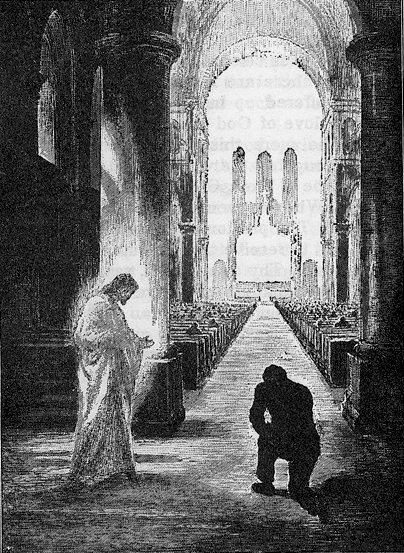
He is no less present to you when you kneel before Him ... and close your eyes ...

Where?

The Tabernacle: Jesus 
in the Most Blessed Sacrament of the Altar
 
In the Tabernacle ... in that little gold House of the Living God within which He dwells really and truly ... in the Most Blessed Sacrament of the Altar ... under what only appears to be a humble Host; what, to the eyes, is only bread. Bread? Yes, Bread! "The Bread of Angels that has come down from Heaven" and which to eat is life everlasting (St. John 6:48-52). He is there!
You will find the Tabernacle behind the Altar – or, sadly, often shunted off to the side, but if you look carefully, you will find it, and when you find it you will find Him! Most often it has a little door (for Him Who is "the Gate") upon which two engraved angels face each other in adoration of Him within. But they are made merely of gold. You are made in the very image of God!
Do no less than the angels ... and adore Him Who awaits you there.


  • What we have learned today: JESUS CHRIST is really and truly present, Body, Blood, Soul, and Divinity – as really as you or me in the Tabernacle ... under the appearance of Bread ... HE IS THERE!
     

Saturday, October 16, 2010

The Most Holy Sacrifice of the Mass: A Primer for Clueless Catholics

Starting today I will be posting a series of talks on the meaning of the Mass courtesy of the The Boston Catholic Herald. And even if you were never one of the people the first part refers to, I think we can all gain something from reading this little series. I personally found it to be a beautiful reminder of how rich and transforming the Mass can be. At the bottom of each daily post you will find a link to the actual website that I found this on, for those who do not want to wait for the next days post you can just jump ahead at your own pace.  Enjoy!

God Bless,
Dominique


The Most Holy Sacrifice of the Mass: a Primer for Clueless 
Catholics
 

A PRIMER for CLUELESS CATHOLICS

The Holy Sacrifice of the Mass

Part I

We are Clueless

Admit it.

You haven't the foggiest idea what is going on during Mass.

You may not even know why you're there.

The reasons are many:
 
  • It's what Catholics do and I am Catholic.
     
  • I want my kids to grow up in this tradition that comes from my parents, grandparents, and forebears throughout the 2000 years preceding my coming into this world through them.
     
  • It is something good to do and it is holy ... although why it is good and why it is holy remains a mystery to me.
     
  • My friends go ... although they do not know why either.
     
  • I need God's help, and if I go to Mass He will look favorably on me.
     
  • God is there ... although just how He is there, I do not understand – after all, God is everywhere, right? – so why is this place so special?
     
Do not be ashamed. It is not your fault. There are answers – good answers – for all the questions this short list brings up.

Y
ou were never taught.

It is really that simple. No one took the time to sit down and talk with you about what is the most important event in your life – and it occurs every 7 days. In fact, whatever else you do during the other 167 hours of the week (job, school, charity – in fact, every other responsibility, necessity, or good work) however good, kind, lofty, noble, pales in significance to the Mass.
 

The Basics:

Before you go further in this brief study – and it is a study that we invite you to – of the single most important thing in your life, we must make a promise to you first: it will not be dry or boring, nor will it be fraught with meaningless pieties. You will understand what the Mass is, why it is holy, and why you must be there. This is our promise to you.
It will not be "socially correct", sanitized to sensitivities, or keeping in step with the passing fads that blow through the pews and across the Altars as so many shifting winds following that elusive mantra of "what is in vogue". There is perpetuity in the Church, and unchangeable elements of the Mass. Hopefully, we will enable you to see beyond the Mass so often presented as entertainment, hosted by an entertainer, to the deep and very sacred reality within it.

"
The Mass", as we most often call it, is really short for, "The Most Holy Sacrifice of the Mass".
 Linger a moment on those 7 words, for they contain quite nearly everything that you will need to know in order to understand why you go to Church, or why you ought to.

The Mass, first and foremost, is a Sacrifice. Not a figurative sacrifice, not a mere remembrance of something done long ago, and not a metaphor. It is a real sacrifice. At Mass you are witnessing – even participating in – a sacrifice, very real and very present.

Does that surprise you?

We do not hear very much about this – but unless we understand this most fundamental, this absolutely central aspect of the Mass, nothing else makes sense. Our lack of understanding the Mass as a Sacrifice contributes to most of the confusion that surrounds our going there and being there.

But what is the nature of this Sacrifice, and how is it enacted? Who does the sacrificing and who or what is sacrificed? How do we ourselves participate in it?

Tomorrow we will begin to understand.

Lord ... 
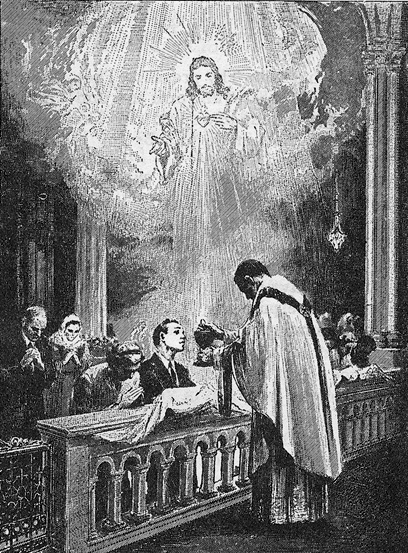
dost THOU come to me ...? The Sacrifice at Calvary that occurs during the Mass Holy Communion --- Receiving the Real Body and Blood of Jesus 
Christ
(click any graphic above to expand it)


Modest dresses? Modest Women?

"A dress should be tight enough to show you're a woman and loose enough to prove you're a lady." Edith Head

Several months ago while trying to help a friend find modest bridesmaid dresses for her daughters wedding I came across some interesting interpretations of what constitutes "modest dresses." After searching high and low in bridal stores, dress shops, and several thrift shops and consignment stores to no avail we took our search to Google. (Just a short side bar here, I have found that if one is looking for affordable, modest, original clothing thrift stores and consignment stores are always the way to go, however when you need four dresses of the same style but in different sizes it gets a little trickier!)

My daughter and I spent some time together looking for websites that might have modest, reasonably priced, tasteful, bridesmaid dresses, and found a few. But what struck me when we started our search were the first couple of websites that we came across that fell under the heading "modest dresses" where anything but! Oye Vey! Here are some examples of the clothes that came up under modest attire....


These were the tamer ones, the others showed way more cleavage and leg than I am comfortable publishing. One of my favorites was a report on no pant pants....sheesh that one is worthy of a post all on its own!!! 
Sorry I guess I did put in a little flesh, but this one was a must see!
Now some might look at these and think well, OK not the most modest but definitely not as immodest as some of the clothes out there in the high schools, malls, or just walking down the street.  I would say that we have become so accustomed to indecency around us that many no longer even notice it until it is shoved in your face. We have moved the modesty bar down so low because we have forgotten what the purpose of modesty really is. And if we understand the purpose of modesty, it then becomes clear that the above styles, like most of today's styles fail the modesty test miserably.

So what is the purpose and end of modesty? Why is it important? Is it necessary in our enlightened culture where men are supposed to be able to control their urges and not be tempted by the sight of feminine flesh?

Modesty is defined in the Oxford English dictionary as: behaviour, manner, or appearance intended to avoid impropriety or indecency. Modesty is also typically understood as a virtue that has as it's purpose and end to protect and preserve purity. In other words modesty as a virtue is at the service of purity. Purity could be understood as the centre of the human person, that part of our nature that is free from corruption, moral, intellectual, physical, and spiritual. Purity cannot exist or survive without the safeguard provided from many different virtues, temperance being one of the more crucial virtues and modesty an integral part of temperance. It is in this context that I would like to talk about modesty. Modesty as it protects "the intimate centre of the person...(as) it guides how one looks at others and behaves toward them in conformity with the dignity of persons." 2521 Catechism of the Catholic Church

Here we see modesty explained as a virtue by the Catechism of the Catholic Church:
2522
Modesty protects the mystery of persons and their love. It encourages patience and moderation in loving relationships; it requires that the conditions for the definitive giving and commitment of man and woman to one another be fulfilled. Modesty is decency. It inspires one's choice of clothing. It keeps silence or reserve where there is evident risk of unhealthy curiosity. It is discreet.

2523
There is a modesty of the feelings as well as of the body. It protests, for example, against the voyeuristic explorations of the human body in certain advertisements, or against the solicitations of certain media that go too far in the exhibition of intimate things. Modesty inspires a way of life which makes it possible to resist the allurements of fashion and the pressures of prevailing ideologies.

2524
The forms taken by modesty vary from one culture to another. Everywhere, however, modesty exists as an intuition of the spiritual dignity proper to man. It is born with the awakening consciousness of being a subject. Teaching modesty to children and adolescents means awakening in them respect for the human person. 


So modesty properly understood, and in the context of my search of modest clothing in particular, refers to a means of protecting persons from being objectified, that is from being viewed as an object of desire, of entertainment, and even in some cases of abuse. Modesty in dress is meant to allow us to be seen and recognized with a dignity that is intrinsic to our very being. It takes away the temptation of seeing not the person but rather the sexual appeal the person, and the woman especially,  may inspire. It allows us to be taken more seriously, more truly, in all walks and at all stages of life. In a way it is the uniform of personhood.

Why is modesty generally addressed more toward feminine attire than masculine? Are there standards of modesty for men as well as women. Yes of course there are standards for men, and men like women should follow a standard of behaviour and dress that reflects his human dignity, but the fact is an indecently dressed man does not threaten the virtue of purity nearly as readily as an indecently dressed woman. I am of course speaking in generalities, and do not discount the existence of women who are easily lured into impurity and objectification of men by indecency, but generally speaking it is men who tend to be more visual, tend to be more easily tempted into lustful thoughts and tend more easily to objectify women as tools for their sexual gratification. We need only look at the epidemic level of male addiction to pornography to recognize this truth.

To dress modestly, to dress with a notion of self respect is also to dress with an understanding and respect for others. Comfort, convenience, desires, fashion trends, should not be the primary motivator behind how we dress. Rather, charity, self respect, personal dignity are more appropriate motivators. As to what is appropriate or exactly what should qualify as modest clothing is not set in stone or condemned to a strict code as some might think, at least not in my opinion. I do believe there are more modest and less modest choice that can still qualify under appropriate attire. For example some might argue that only skirts and dresses past the knee, well fitted but not so tight as to make movement difficult or pantie lines visible, are to be considered appropriate for women. Blouses and shirts should not be lower than two fingers past the collar bone, and should not come up to uncover the mid-drift or be so tight as to show outlines of undergarments, with sleeves that cover the arm up to the elbow. Now while I do think that the above examples are the most modest and feminine choices a woman can make, I do not think that a woman in a loose fitting suit  or trousers with a feminine blouse is not necessarily immodest. I also recognize that sometimes wearing a skirt for certain activities may sometimes prove to be impractical and immodest.

I also understand that one can be dressed perfectly modestly and femininely and still behave in an immodest manner, but I also know from my own personal experience that dressing modestly can go a long way to help remind us that we are ladies and as such should be behave like ladies. 
In the end I am convinced that a return to at least some standard of modesty in dress and behavior is needed. I see far too often the outcome of women being viewed and treated as objects, being stripped (excuse the pun) of their dignity. I believe we women have a responsibility to ourselves and to our brothers to be and dress more modestlythan what is currrently accepted as appropriate. And I believe that Archbishop Fulton Sheen expresses it best when he tells us: "To a great extent the level of any civilization is the level of its womanhood. When a man loves a woman, he has to become worthy of her. The higher her virtue, the more her character, the more devoted she is to truth, justice, goodness, the more a man has to aspire to be worthy of her. The history of civilization could actually be written in terms of the level of its women.”

God Bless,
Dominique


PS Below you will find a video with Jason Evert on why guys think modesty is important...

Jason Evert - Why Modesty?